| History |
|

When you visit the reconstructed fort today, you
will find historical interpreters dressed in 18th century frontier
clothing and involved in activities which would have been found on the
Virginia frontier at the time: farming, spinning, weaving, carpentry,
blacksmithing, and repairs to buildings, tools and weapons, as well as
other activities. The interpreters, working as laborers and artisans
in the fort, will be able to talk with you about their activities,
both as they existed on the early frontier and as they developed
later, when the first communities were beginning to appear.
The reconstructed fort you see today represents the
original fort as it would have been found during a period of quiet.
You will probably not see any militia activity, unless you are here
for a special event. You will, however, find most of the weapons and
equipment used by militiamen and be able to talk to interpreters who
are knowledgable about militia functions and weaponry. You might even
find a native interpreter at the fort, dressed as a Shawnee warrior,
who can talk with you about military matters from the American Indian
point of view, as well as Shawnee culture in general.
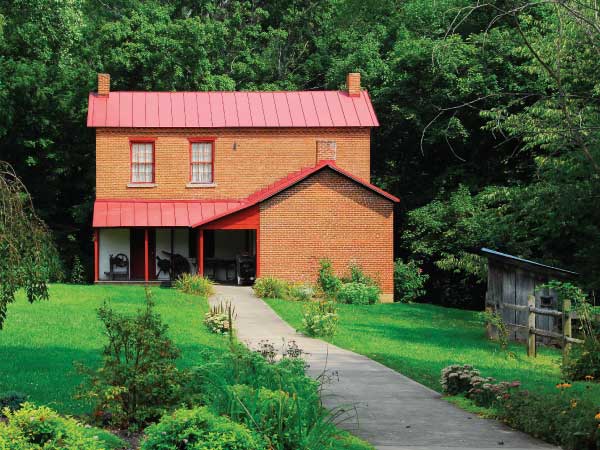
The Prickett family continued to live on the
original Prickett homestead for just under two centuries: from the
1770's until the 1960's. About 1859, construction began on what is now
referred to as the Job Prickett house, and it is this structure which
still stands, a mere stone's throw from the reconstructed fort. After
visiting the fort, you might consider taking a tour of the house. To
do so will be to move forward through the history of one family, and
this history of the country, almost ninety years, from the eve of the
American Revolution to the eve of the Civil War.
|
| The Fort |

Pricketts Fort, constructed in 1774, provided a
place of refuge from American Indian attack for early settlers. It was
built at the confluence of Pricketts Creek and the Monongahela River
within 10 miles of three major American Indian trails. The Fort, which
covers a 110 by 110 foot square, was built by the community militia
and is named after Captain Jacob Prickett.
Two-story blockhouses are set in the four corners of
the 12-foot high log walls and were used by the Fort's defenders as
lookouts. Lining the weathered stockade walls are 14 tiny cabins, some
with earthen floors, which served as shelter for the women and
children. A meeting house and storehouse fill the common. There are
two large gates: one double gate facing north and one smaller gate
facing west.
When the threat of American Indian uprising
occurred, up to 80 families from the surrounding countryside would
gather at the Fort. Referred to as "forting up," the families would
stay as long as the threat existed, from days to weeks. Under cramped
and primitive conditions, the settlers understood life in the Fort to
be a sacrifice for survival on the dangerous frontier of the late
1700's. Today's Fort still speaks eloquently of that life and time.
[top] |
| Job Prickett House |

Just south of the Fort stands the Job Prickett House
built in 1859 by Captain Jacob Prickett's great-grandson, Job. This
original structure has been restored to provide visitors a glimpse of
the progress that took place at the Fort between the 18th and 19th
centuries. Although still primitive by today's standards, the brick
home illustrates the evolution of an increasingly civilized lifestyle
and the availability of mass-produced furnishings.
The simple floor plan of the home is typical of a
19th century farmhouse, however, Job Prickett incorporated several
unique architectural styles to the exterior. The front of the home
reflects Federal style with two doors and four windows. The Greek
Revival style was used in the appearance of the flush chimneys and the
four panel doors with transoms above them.
Many of the family's original furnishings, tools and
handmade objects have been carefully preserved and are on display in
the house. The house is listed on the National Register of Historic
Places.
[top] |
| American Indians in West
Virginia . |

Virginia-Pennsylvania frontier a place of
countless dangers, it was the presence of numerous Indian tribes,
in particular the Shawnee, which Europeans especially feared. For
centuries the Shawnee, Mingo, Wyandot and Lenape/Delaware tribes
lived throughout the upper Ohio Valley. Pricketts Fort was never
directly attacked by Indians and written documentation of any
interactions between people living on the grounds of the fort and
American Indians is sparse. Many historians believe that between
the 1600's and 1800's the area that encompasses modern-day West
Virginia was a hunting ground for Eastern Woodland Indians such as
the Shawnees and Delaware. Since hunting and gathering were
activities by which American Indians sustained their lives, they
considered West Virginia their home.
Testimonies from the earliest traders and
settlers in the region make clear that there were small Indian
settlements scattered throughout the region in the first half of
the 18th century. It is well known that there were extensive trade
relationships between the Indians of the Ohio River Valley and the
European frontier settlers during the 18th and 19th centuries.
Between the 1700's and 1800's the Ohio River Valley was alive with
interactions between Woodland peoples and European settlers.
During this time, many treaties were made and wars were fought.
Often times, land ownership was at the root of these
confrontations. Documented evidence suggests that some of the
primary Indian inhabitants of the middle Ohio River Valley during
the 1700's and 1800's were people who spoke two general languages:
Macro-Siouan, particularly Iroquoian languages, and
Macro-Algonquian. These people can be traced to the ancestors of
modern day Shawnee, Delaware, and Iroquois people.
|
| Video |
Experience the pioneering spirit of
early settlers as we present you with a glimpse of Pricketts Fort State
Park. See the landmarks and meet historical interpreters just as they
appear at the Fort today. Learn about the history of the Fort. But be
prepared; we think once you've seen the video, you'll just have to come
experience Pricketts Fort for yourself.
The player will show in this paragraph
[top] |
|
 |
|